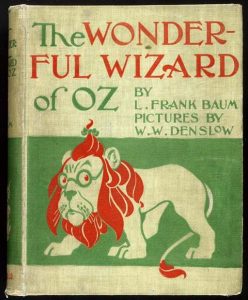
 Seventy years ago the Metro-Goldwyn-Mayer film The Wizard of Oz opened in movie theaters around the world. Although the initial 1939 release of the movie failed to earn much more than the costs of production, advertising, and distribution, it has since earned millions of dollars in revenue from licensing fees. As the world celebrates the 70th anniversary of The Wizard of Oz, we take a look at the current federal copyright protection for this beloved classic and determine when the movie will lose that protection and enter the public domain. Dorothy Gale began as a character in the children's novel The Wonderful Wizard of Oz, authored by Lyman Frank Baum and illustrated by William Wallace Denslow. Baum, more commonly known as L. Frank Baum, was born May 15, 1856 in Chittenango, New York. After several careers including store proprietor and newspaper editor, Baum partnered with Denslow in Chicago, Illinois in 1899 to publish the nonsensical poetry book Father Goose, His Book. Less than a year later the duo completed their second and most popular collaboration, The Wonderful Wizard of Oz. The Wonderful Wizard of Oz was first published by the George M. Hill Company on May 17, 1900 and according to some sources was officially registered with the United States Copyright Office on August 1st of that year. The book was instantly a best-seller, and in the 109 years since its first publication it has sold millions of copies in countries all over the world. Copyright and Baum's Book When the novel was published, the duration of copyright protection was still determined under the Copyright Act of 1831. Under this Act, a work was eligible for an initial 28-year term of protection beginning on the date of publication (which was double the 14 years granted by the original 1790 Copyright Act). At the end of the initial 28 years, the term could optionally be extended by the copyright holder for another 14 years, resulting in a total 42 years of copyright protection. As a result, The Wonderful Wizard of Oz was set to enter the public domain in 1942. However, just 9 years after the novel was published Congress passed the 1909 Copyright Act. This Act kept the initial copyright term of 28 years but extended the renewal term from 14 years to 28 years for a total 56 years of protection. Since the extension applied to works with existing copyright protection as well as future works, Baum and Denslow received a 14-year extension of their copyrights. Unfortunately, Baum and Denslow were not able to enjoy the success of their novel for very long; Denslow died at age 59 in 1915 and Baum died at age 62 in 1919. The Wonderful Wizard of Oz, however, continued to prosper. In 1928 the copyright registration was renewed for an additional 28 years, and just a few years later Samuel Goldwyn purchased the screen and book rights the novel for the sum of $40,000. In 1956, just fifty-six years after Baum wrote the novel, the second 28-year term ended and the novel entered the public domain. (a free digital copy of the original The Wonderful Wizard of Oz can be obtained from the Gutenberg Project). Although the children's novel The Wonderful Wizard of Oz lost copyright protection in 1956, only the original novel by Baum and illustrations by Denslow have entered the public domain. Any newly-created material such as illustrations created for a new publication of the novel, will still be eligible for copyright protection because they are new works. Similarly, any derivative works based on the novel will potentially be eligible for protection. Section 101 of the Copyright Act defines a "derivative work" as "[a] work based upon one or more preexisting works" or "[a] work consisting of editorial revisions, annotations, elaborations, or other modifications, which, as a whole, represent an original work of authorship." Accordingly, new material added to an annotated version of the novel created, for example, in anticipation of the up-coming 110th anniversary of the novel's publication would not be in the public domain. The author of this new material would have a protectable interest in her work. Perhaps even more confusing, a new compilation of some of Baum's Oz-related stories might be eligible for copyright protection even if all those novels have been in the public domain for years. The creativity involved in selecting which public domain stories to include, and in what order to include them, would likely be eligible for copyright protection. Accordingly, although someone could copy all the individual stories within the Oz compilation (provided they did not have any new or otherwise protectable material), they could not copy all the works and then provide them in the same manner as the protected compilation. However, if someone selected all of Baum's works and presented them in chronological order in a compilation, there would likely not be enough creativity to establish copyright protection. When analyzing the copyright status of a work such as The Wonderful Wizard of Oz, it is important to note the contributor or creator of each part of the particular work in question. Copyright and the 1939 Film Unlike Baum's novel, the classic film The Wizard of Oz is still protected by copyright, but only as a result of several extensions granted by Congressional enactment. Under the 1909 Copyright Act, the 1939 film was eligible for a total 56 years of copyright protection (an initial 28-year term plus a 28-year renewal). As a result, someone living between 1939 and 1962 and planning to celebrate the day that Oz entered the public domain would have 1995 circled on their calendar (1939 + 28 years + 28 years). Indeed, if there had not been any additional reform of copyright duration, Judy Garland's famous portrayal of Dorothy Gale would have already been in the public domain for 14 years. Between 1962 and 1974, however, Congress passed several pieces of legislation that slowly increased the duration of copyright protection, each temporarily delaying the impending termination of copyrights in their second term. The 1974 extension, for example, delayed any terminations set to occur between 1962 and 1976 until December 31, 1976, effectively extending the length of the renewal term from 28 years to 42 years. By now the poor party-planning soul was completely unsure of the date that Oz would enter the public domain, but was tentatively making plans for 2009 (1939 + the 28 year initial term + a 42 year renewal). This year's 70th anniversary celebration of The Wizard of Oz might have also seen the movie enter the public domain. Once again, however, Congress stepped in to enact one of the biggest reforms of copyright law in history. Under the 1976 Copyright Act, the renewal term for works that had been created prior to January 1, 1978 were extended to a total of 47 years, thereby adding another 5 years onto the term of Oz's current copyright and delaying the date it entered the public domain from 2009 to 2014. The Act also set which day of the year a work would lose protection, providing that all terms of copyright would run through the end of the calendar year in which they would expire. As a result, Oz was set to enter the public domain at the stroke of midnight on December 31, 2014. Twenty-two later, however, Congress passed the Sonny Bono Copyright Term Extension Act and The Wizard of Oz received the longest term extension to date. For pre-1978 works that were still under copyright protection, the Act extended the renewal term from 47 years to 67 years, resulting in a total 95 years of protection from the date of publication. By now the party-planner was likely apoplectic but hopefully in good enough health to wait until 2034, the year that the movie is currently scheduled to enter the public domain:
| Act |
Initial Term |
Renewal Term |
Date of Publication |
Projected Public Domain Date |
1909 Copyright Act
|
28 years |
28 years
|
1939 |
1995 |
| 1974 Amendment |
28 years |
42 years |
1939 |
2009 |
| 1976 Copyright Act |
28 years |
47 years |
1939 |
2014 |
| 1998 CTEA |
28 years |
67 years |
1939 |
2034 |
The Wizard of Oz has been fortunate to enjoy the many term extensions granted by legislation during the past 50 years. Indeed, the duration of the movie's copyright protection has been extended by a total of 39 years from an original termination date of 1995 to the current date of midnight, December 31, 2034. The movie's 95 years of copyright protection will be a great deal more than the 56 years given to Baum's original novel. While it remains a possibility that Congress could once again prolong the duration of copyright protection for older works such as the 1939 film, the current terms of duration are relatively similar to terms around the world. It is very likely, therefore, that at midnight on December 31, 2034, The Wizard of Oz film will enter the public domain.



 In late March, the United States Copyright Office proposed increased fees for copyright registrations (the public notice in the Federal Register is available at:
 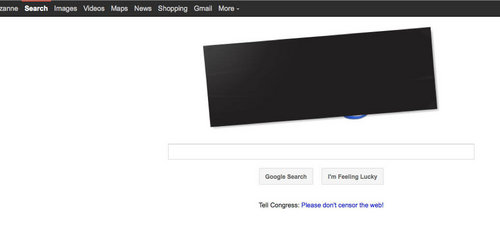 Today, websites, companies, and individuals around the country are participating in the largest online protest in history as they battle two proposed bills currently pending before Congress, the Stop Online Piracy Act (